“Not as bad as it sounds”: NATO and the Pitfalls of Self-Promotion
By Michael Rühle
***
The author offers his personal observations on some of NATO’s unintentionally funny public diplomacy failures.
On 4 April 1949, at the signing of the Washington Treaty, the State Department band played a medley from George Gershwin’s musical “Porgy and Bess” as a tribute to First Lady Bess Truman. To some listeners, songs such as “I Got Plenty o’ Nuttin'” and “It Ain't Necessarily So” seemed like an ironic commentary on the presumably short life expectancy of the newly founded transatlantic alliance. Fortunately, NATO, to borrow Mark Twain’s quip about Richard Wagner’s music, “isn’t as bad as it sounds.” The alliance, which is soon to celebrate its 77th anniversary, has time and again defied the critics who predicted its end.
However, NATO constantly lives with the fear that it could lose its relevance. The main reason for this is the way in which the media reports about it: any allied disagreement is interpreted as heralding NATO’s imminent demise. No one has described this absurd ritual more aptly than veteran journalist Jim Hoagland. In a brainstorming session near Brussels right before the controversial Iraq War, he advised a group of nervous NATO Ambassadors to remain calm, pointing out that “whenever we at the Washington Post have a slow news day, we publish a ‘whither NATO’ piece.” For Hoagland, the strategic value of the alliance was never in question, and even the Iraq war would not render it irrelevant.
Hoagland was proven right, yet the composure he called for is difficult to find at NATO Headquarters. Inside that huge building people are fighting a constant battle for public goodwill. Not surprisingly, the temptation to ‘sell’ the alliance by displaying an almost pathological optimism sometimes becomes overwhelming. Alas, this approach is rarely met with success. In its relentless efforts to present itself as a knight in shining armour, NATO has repeatedly gone off the rails.
The selection of inappropriate music, for example, was not limited to the founding ceremony 77 years ago. To celebrate the alliance’s 10th anniversary in April 1959, Bing Crosby released his “NATO Song,” a Country and Western ballad with cheesy lyrics praising “the NATO shield.” In 2004, when the alliance welcomed seven new members from Central and Eastern Europe, the band played the theme from James Cameron’s blockbuster Titanic. Perhaps the only musical piece that did not cause embarrassment was the “NATO Hymn,” written in 1989 by a Luxembourg officer, even though it sounded as if it had been written for a funeral.
The acoustic peculiarities were accompanied by visual bloopers. Anyone who visited NATO Headquarters in the late 1980s could watch a promotional film about the value of the alliance. It showed soldiers, tanks, warships and fighter planes, and the distinctive voice of Hollywood star Charlton Heston provided the powerful narration. The message was simple and clear: NATO was the free West’s military bulwark against the Soviet threat. Movie and message worked hand in glove.
However, when the Cold War ended, NATO’s new video no longer showed soldiers or weapons. Instead, it tried to convey that the new European peace order was largely a matter of extensive handshakes between diplomats in ill-fitting double-breasted suits. Charlton Heston’s gravelly voice was replaced by the nasal timbre of a British NATO employee—a cost-cutting measure. The final images of the film no longer showed a fleet of proud aircraft carriers, but rather, white doves rising from the Spanish Steps into the blue sky above Rome. In its visual self-portrayal, at least, NATO had thoroughly demilitarized itself.
Some years later, NATO even tried its hand at a short feature film, to be distributed on DVD, in which real actors played different NATO employees who were going about their daily jobs at Headquarters while an international crisis was unfolding. The story made little sense, because it remained utterly unclear how these individuals related to the crisis. Nor was the abrupt end of the crisis explained. It just ended, presumably because NATO had issued some fiery statements (just as in real life!). When the movie premiered in front of NATO staff, the awkward silence was followed by some hesitant mercy applause, because nobody wanted to frustrate those colleagues who had worked so hard and achieved so little.
Times have changed again, and so have NATO’s videos. Since Russia’s annexation of Crimea in 2014, NATO has not been shy about emphasizing its military character. The propagandistic drought, during which a desperate NATO Public Diplomacy Division even hired the top advertising strategist of a U.S. soft drink company to refresh the alliance's ‘branding’ with a ‘transformational narrative,’ is over. Today, footage of soldiers and heavy military equipment signals the alliance’s unflinching determination to defend ‘every inch’ of NATO territory. Take that, Putin! However, displaying military equipment does not always have the desired effect. At the 2014 summit in Wales, for example, NATO attempted to emphasise its renewed military toughness by displaying a fighter jet in front of the conference hotel. Alas, the desired touch of Top Gun quickly backfired. The press mocked the fact that it was only a large plastic model—a real aircraft would have damaged the well-manicured English golf course. And, as we know from President Trump, golf is more important than NATO.
NATO reached its visual low point at its 2021 summit in Brussels. In the ‘Agora,’ the huge, dimly lit hall at the center of NATO Headquarters, technicians had erected a cube of several meters’ height. Its black surface allowed the projection of images and videos. The resemblance to the monolith in Stanley Kubrick’s science fiction classic 2001: A Space Odyssey was obvious to everyone. When it came to taking the ‘family photo,’ due to COVID social distancing regulations, NATO Heads of State and Government were directed to precisely defined markings around the monolith. However, the result resembled a gathering of UFO enthusiasts waiting for the long-awaited spaceship to arrive at dusk. Once again, NATO had failed to stage itself visually.
The UFO monolith will not remain NATO’s last visual blunder, yet the Alliance will survive its occasional propagandistic missteps. After all, it even survived the three viral videos commissioned for its 60th anniversary in 2009. The argument that it was impossible to produce a viral video, since popularity was entirely in the hands of the audience, was ignored. NATO’s public diplomacy experts insisted that these videos were so attractive that they simply had to go viral. The result? Three confusing forty-five-second spots that failed to convey a coherent message. Even after several weeks, they had received little more than 4,000 views, which—perhaps not coincidentally – corresponded to the number of employees at NATO Headquarters. The videos, which had been produced at great expense, disappeared. They were simply irrelevant. NATO, by contrast, remains very relevant, which is why it is likely to stay around for a little longer.
Michael Rühle worked for over thirty years on NATO’s International Staff, including as a speechwriter for six Secretaries General. In the hope of boosting his IQ, he touched the monolith at NATO Headquarters, as he had seen the apes do in Stanley Kubrick’s “2001: A Space Odyssey.” Unfortunately, the monolith did not work.
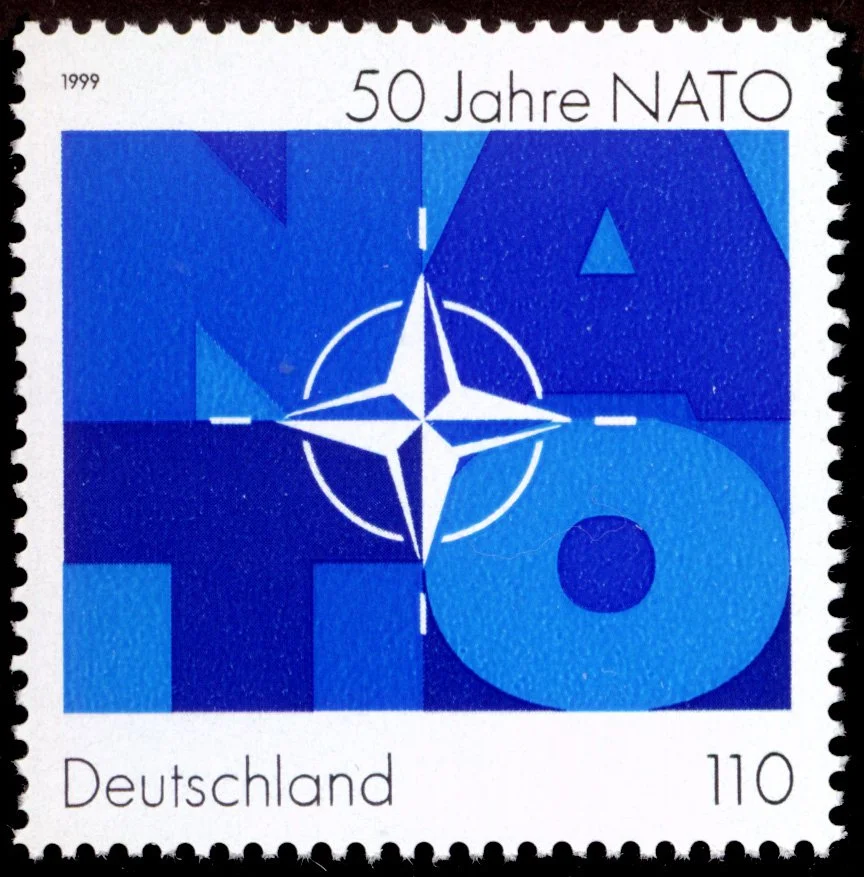
Stamp from Deutsche Post AG from 1999, 50th anniversary of NATO (Deutsche Post AG).
Licensed under CC0.