
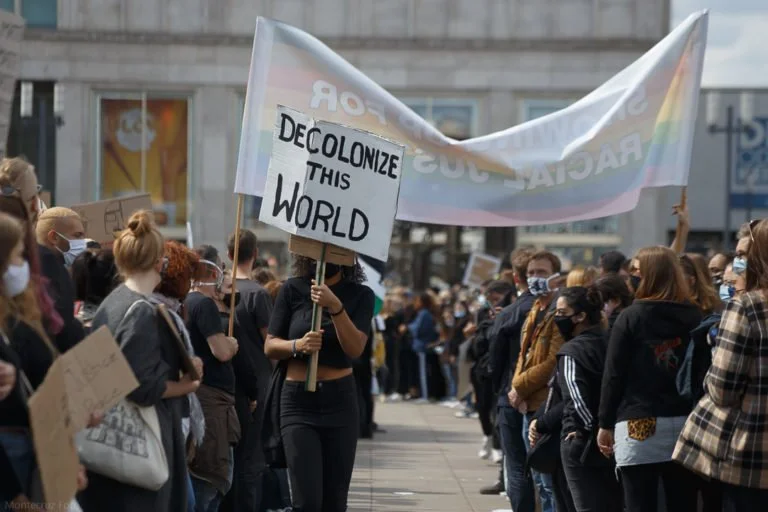
The 2025 Decolonizing International Relations Conference
By Hannah Patterson and Stuti Kulkarni
***
Current domestic and international instability has served as a persistent reminder that the international system as we know it is evolving. As power shifts unsettle entrenched global governance systems, it becomes increasingly difficult to ignore the deep imbrication and interconnection of famine, genocide, severe inequity, and growing sociopolitical unrest. However, these patterns are not new, and when our gaze is lifted, many speak directly to the ongoing and pervasive impacts of coloniality. It is within the fierce urgency of this moment that the decolonial and anti-colonial imperatives have become increasingly salient, for those in and outside of academia.
The 2025 Decolonizing International Relations (DIR) Conference sought to engage directly with this moment by focusing on tangible strategies to translate decolonial thought into everyday, embodied practice. This year’s conference built on its previous six, entirely student-organized iterations, which began in 2018. Originally, the conference emerged as an inquiry into the pedagogy at Fletcher, focusing on curriculum design, and syllabus content with the intention of creating a platform through which a more diverse array of perspectives could be engaged and celebrated.
The DIR Conference's first edition began with three panels, and seven years later, it has developed into a two-day event, with session themes spanning pedagogy, gender and sexuality, environmental justice, racial capitalism, settler-colonialism, international law and policy, migration, and spatial representations of coloniality. This year, the conference hosted over 150 registrants with twenty-four speakers from across the world. While attendance is an important marker of engagement, given this year’s theme of Reorienting Theoretical Apertures & Embodying Decentered Practice, we were also particularly focused on capturing impact through participant reflections underscoring how the decolonial perspectives discussed in each panel shifted their way of thinking about their topics of interest.
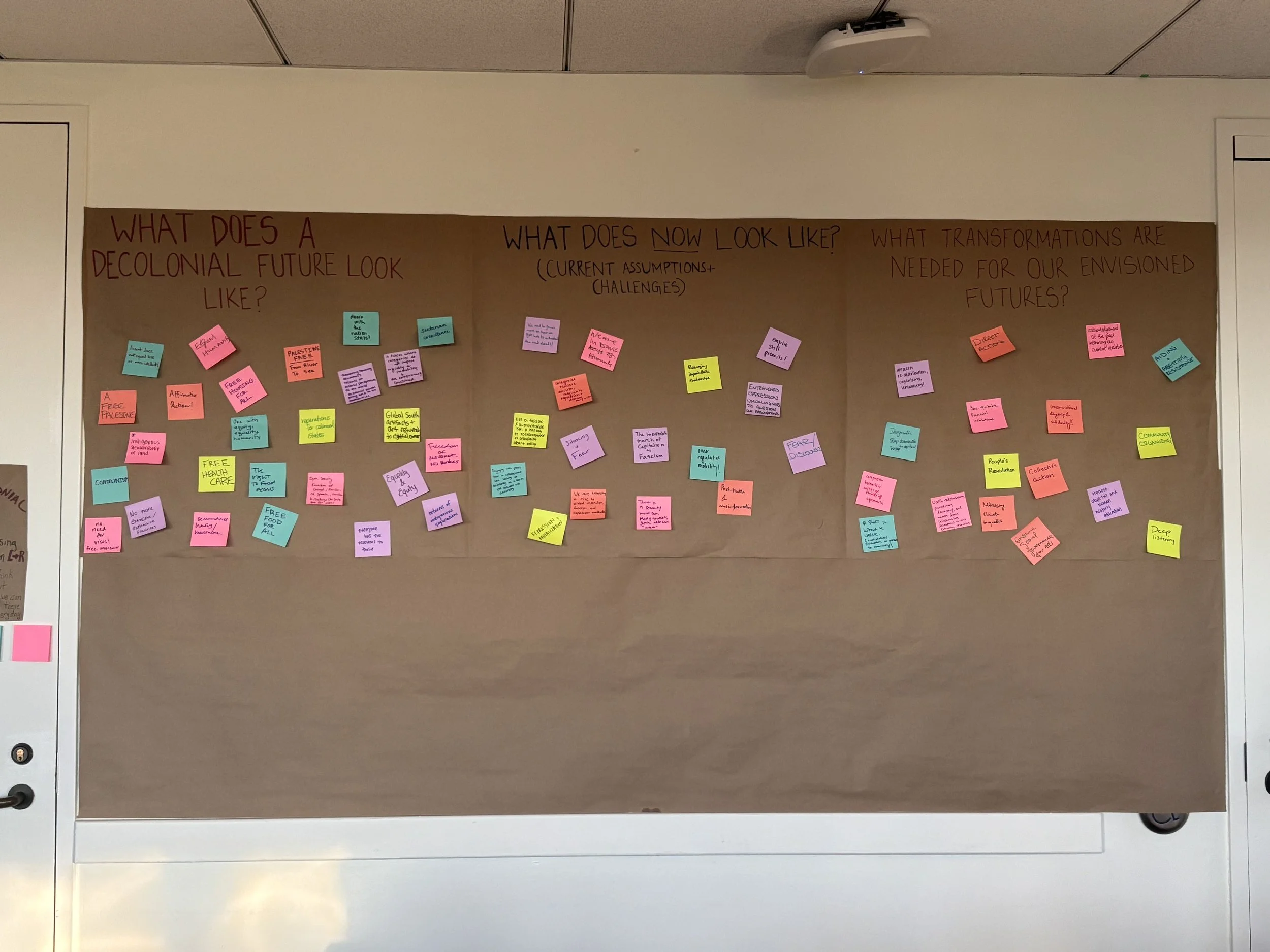
What does a decolonial future look like? // What does now look like? // What transformations are needed for our envisioned futures — Audience Responses
Through this year’s theme, we encouraged participants to engage with decoloniality as an ongoing practice and to consider the quotidian, often invisible, ways our language, social and political systems, cultural intersubjectivity, economic lives, spatial arrangements, pedagogy and learning are all steeped in coloniality. We sought to cultivate a sense of solidarity amongst students, scholars, and practitioners to build active, transformative, and contestatory means of thinking about how oppressive power dynamics and patterns of doing, thinking, and being are rearticulated in our daily lives. In his keynote address, Dr. Bayo Akomolafe underscored how conceptualizations of belonging influence our ability to collectively build worlds that we do not yet know within our tangible interpersonal relationships.
Taking this relationality as a point of entry, the conference sought to ground discussion of decoloniality in our own lived realities here in Medford and the greater Boston area. To build on this, we designed two panels that offered participants new ways of thinking about the key themes highlighted by the DIR Conference each year.
Through a panel titled “Unsettling the Everyday: Embodying Decoloniality in the Quotidian” , speakers and participants engaged with how colonial structures of oppression manifest through visual cultures and language, constructing and erasing subjectivity. Discussion centered around how daily practice and artistic engagement can serve as powerful forms of transgression against these ‘everyday’ assertions of colonial power and dominance.
A session titled “Colonial Spaces We Inhabit: Resisting Through Solidarity, Community Care, and Collective Organizing” intentionally challenged participants to think critically about how the legacies of colonialism manifest through the ways we perceive and live in the spaces we inhabit. Discussion focused on lived experiences of gentrification, ‘town & gown’ relationships, and practices of spatial exclusion here in our communities, highlighting practical strategies for cultivating collective solidarity with marginalized communities in and around Tufts University through mutual aid, labor organizing, and counter-institution building.
Additionally, we sought to interrogate our own assumptions regarding the production of knowledge by ensuring that all of our panels decentered traditional epistemologies in order to recenter perspectives emphasizing the complexity of regions and themes that are often generalized and understudied. We designed each student-moderated panel such that through their own work and personal identities, speakers unsettled the strict delineation between academic, practitioner, and activist, empowering students to build new skills and celebrate their own expertise in specific issue areas.
As we look to the future, we cannot wait to see what the next Chairs imagine for the eighth DIR Conference, and we hope that this Conference can remain a critical component of Fletcher’s curriculum. In the meantime, we encourage students to stay tuned for upcoming events hosted by the DIR Student Club, keep interrogating our own capacity to shape how knowledge is produced, and continue to find new ways to resist and care for each other as we all endeavor to imagine and practice decolonial futures every day.
Hannah Patterson is a Master of the Arts in Law and Diplomacy candidate at the Fletcher School, specializing in conflict resolution and international law. She has a background in peacebuilding and multilateral engagement, working previously at the Quaker United Nations Office and then as the General Assembly General Assembly Policy Adviser for the UK Mission to the UN.
Stuti Kulkarni is a Master of the Arts in Law and Diplomacy candidate at the Fletcher School, specializing in conflict resolution and human security in South Asian borderlands. She has worked previously with grassroots gender justice organizations and diaspora-led development agencies in New Delhi, India.
Montecruz Foto
Licensed under CC BY-SA 3.0.
