
A Condominium Without Commitments
A New Reality in U.S.–Russian Détente?
By Yury Nadtochey
***
After years of political confrontation, sharp rhetoric, and battles over sanctions, Moscow and Washington are once again cautiously edging back toward the idea of reviving bilateral dialogue—tentatively, and without much confidence. What is emerging resembles a peculiar form of détente, marked by striking contradictions: openness and secrecy, loud public statements and quiet backroom deals.
The two parties appear to be moving toward what might be described as a condominium without commitments—or a ‘shadow condominium’—a concept close to that introduced into academic discourse by Coral Bell. In her interpretation, the term extends beyond its strictly legal definition. It does not refer simply to the joint administration of territory, but rather to an informal model of coordination in which states tacitly acknowledge each other’s spheres of interest in order to preserve the balance of power.
Condominium as an Informal Model of Coexistence
Contemporary U.S.–Russian relations, with some conceptual assumptions, fit into this framework. Instead of ongoing attempts to build a strategic partnership—a hallmark of the first two decades of post-Soviet diplomacy—a more modest arrangement has emerged. This is neither an alliance nor a union, nor even a set of long term accords. Instead, it is a restrained form of dialogue in which the two sides cooperate on a limited scope of issues, less by working together than by simply refraining from obstructing one another.
It is this logic—not of convergence but of deliberate separation—that defines the current dynamic between Moscow and Washington. What is taking shape is not a partnership, but a relationship of mutual non-interference. With traditional state-to-state diplomacy in paralysis, normalization now rests on a different foundation. Its durability remains uncertain, its rules undefined, yet the trajectory is clear: a structure is emerging in which coexistence without commitments and dialogue without trust replace the principles that once guided bilateral interaction between the United States and the Russian Federation.
This fragile rapprochement is driven less by any desire to construct a new global order than by the need to minimize risks—to take a geopolitical time-out, consolidate strength, and prepare for future contests. Strategic objectives diverge, yet limited and conditional normalization is still preferable to open conflict.
In this model, each party preserves its freedom of action while avoiding direct confrontation by recognizing the other’s rights and interests. It is an arrangement without real precedent in contemporary international relations. Still, since the early 2000s, Russia’s official discourse—punctuated by regular anti-American tropes—has occasionally circled back to the idea of partnership. In those moments, Russian media, experts, and even top officials, often point to historical episodes of cooperation: Catherine the Great’s reign, the anti-Hitler coalition in World War II, and the U.S.–Soviet détente of the 1970s.
Despite their differences, these historical references serve a common purpose: to demonstrate the possibility of peaceful coexistence between two great powers capable of creating a system in which each focuses on its own domain while leaving room for maneuver to its counterpart. In this new geopolitical logic, there is no space for direct clashes, competing claims to the same spheres of influence, or acute rivalries rooted in irreconcilable ideological differences. Russia remains focused on the post-Soviet space, Central Europe, and parts of the Middle East, while the United States concentrates on the Western Hemisphere, the Asia–Pacific, and containing China.
Paradoxically, Moscow’s long-standing aspiration for a multipolar world now seems to find resonance in Washington—even if such a world remains fragmented and poorly governed. Unlike their predecessors, Donald Trump’s team shows little interest in foreign policy messianism, instead preferring an old-fashioned political realism. Yet even this brand of realism differs fundamentally from that of U.S. presidents in the second half of the twentieth century, both Democrat and Republican. The last remaining superpower has once again turned toward the traditions of paleoconservatism and isolationism.
Russian elites abandoned communism in favor of markets, capitalism, and nationalism decades earlier. Belatedly, some conservative American politicians have followed suit, proclaiming fatigue with globalization, international responsibilities, and wars to ‘defend democracy,’ while rallying behind the vague slogan of ‘Make America Great Again’. Thirty-five years after the Cold War, both parties now appear ready to turn the page, renounce grand projects of global ideological transformation, and accept the world as it is.
This pragmatic outlook shapes—and simultaneously constrains—the negotiation process between Moscow and Washington. Political and business elites in both countries increasingly favor closed door, ‘ideologically sterile’ talks focused on mutually beneficial deals, trade, and investment. Yet one feature of U.S.–Russian dialogue, dating back to the Soviet period, endures: personalization. The human factor—the capacity of personal ties between leaders to shape critical decisions—remains a key variable in bilateral relations and will likely do so for years to come.
The record of such deeply personalized diplomacy is not encouraging. Both the George W. Bush and the first Donald Trump administrations’ relationships with Vladimir Putin ultimately failed to deliver durable strategic outcomes. Still, today’s leaders appear to have few effective alternatives. Personal trust between heads of state has become one of the few functioning mechanisms for reducing tensions and balancing interests in specific areas.
For Moscow, the long-sought ‘de-ideologization’ and ‘pragmatization’ of relations with Washington can only take shape within a broader context. In this framework, contentious issues and ‘regrettable misunderstandings’ (such as the Russo–Ukrainian war) are not excluded from the agenda, but at the same time both parties prefer not to get stuck on topics that could obstruct meaningful dialogue. At the same time, space is opening for ‘self-contained’ negotiating tracks in areas like energy, finance, natural resource extraction, and maybe even advanced technologies. Technical and economic issues are moving to the fore, while military and political ones seem to be deferred ‘until better times.’
For the Kremlin, this structure offers hope of at least a prolonged pause in Western sanctions, and at most a pathway toward partial or even full reintegration into the international (or, more precisely, Western) system through a U.S.–Russian ‘breakthrough’ in negotiations, followed by the marginalization of U.S. NATO allies in Europe. Clear signs of Moscow’s progress are already visible in the dramatically altered rhetoric of President Donald Trump and Vice President J.D. Vance toward the Russo-Ukrainian war. White House and State Department officials no longer employ Biden-era accusations of Kremlin “aggression“ and an “unprovoked invasion” . Instead, the Oval Office now frames the conflict as one to be resolved quickly, “irrespective of who started it.” In doing so, the new administration seeks to soften tensions, open the door to more substantive discussion, and create space for diplomatic exchanges—both between the direct parties to the conflict and with other stakeholders, including the United States itself. If this scenario unfolds, Washington may reduce strategic uncertainty by tying Russia into economic projects and, in so doing, neutralize its geopolitical ambitions by establishing more or less interdependent economic ties.
In practice, this means bracketing domestic political issues out of international dialogue, refraining from interference in each other’s internal affairs, and downplaying contentious topics such as democracy and human rights. Instead, emphasis would shift to immediate, organizational matters of cooperation, with the goal of lifting relations at least to a working level while leaving aside high politics such as global security and arms control. In such a framework, U.S.–Russian relations would assume a special configuration: one based on distancing from divisive issues and focusing instead on areas of tangible cooperation. What emerges is a kind of regime of mutual tolerance—not built on elaborate rules, but on tacit taboos. Chief among these is the principle: do no harm to your partner.
The Limits of Normalization
Moscow’s and Washington’s turn to the principle of ‘mutual restraint,’ after years of playing a zero-sum game, could be welcomed were it not for several factors that complicate any forecast of genuine normalization in U.S.–Russian relations.
The first set of factors lies in domestic politics, where the balance of political forces has always shaped the depth and scope of past thaws and détentes. At every stage of U.S.–Soviet/Russian relations, each country had its own ‘party of peace’ and ‘party of war.’ The current situation is no exception. In Russia, opponents of rapprochement with the West are relatively constrained and, in most cases, would reluctantly ‘accept the necessity’ of bringing Moscow back onto a diplomatic track with ‘unfriendly states.’ In the United States, however, the environment is different. Since President Trump’s second term, opposition to his foreign policy initiatives has steadily mounted in both Congress and to some extent in the executive branch, despite the fact that they are both controlled by Republicans. Among senators and representatives, calls for a tougher stance toward the Kremlin—including new sanctions—have only grown louder.
The second set of problems stems from the unequal capabilities of the two parties, where U.S. superiority is unmistakable. This advantage is rooted in the economy, but also in military, strategic, and institutional resources. The United States maintains a global network of military bases, alliances, and partnerships that allow it to project power virtually anywhere. It is deeply embedded in international institutions, functioning as a central node that sets rules and shapes global norms—ranging from international security to climate change governance. The United States’ soft power is reinforced by the English language, world-class universities, and technological leadership. Despite its own political and economic vulnerabilities, the United States remains a nation whose capabilities are unmatched (or at the very least formidable) across most key domains.
Russia’s means of sustaining international influence are far more limited. Since the end of the Cold War, Moscow has relied on selective military deployments and situational alliances with a narrow range of partners. This made its aspirations for equal dialogue with Washington appear questionable to long-time skeptics of a U.S.–Russian condominium. Even so, many Western analysts acknowledge that Russia’s economy retains notable resilience: vast hydrocarbon reserves, low public debt, substantial foreign currency and gold reserves, and a degree of self-sufficiency in critical sectors such as agriculture, defense, and nuclear technology. Yet its structural weaknesses are equally clear. The Russian economy remains relatively small. It amounts to 2.17 per cent of global GDP and is heavily dependent on resource exports—above all oil, gas, and metals. Their importance has only grown since the outbreak of the ‘Special Military Operation’ in Ukraine, with developing world commodity markets becoming essential lifelines for Russian exporters. Meanwhile, long-term challenges—demographic decline, weak financial markets, and limited access to advanced technologies—continue to constrain modernization and sustainable growth. These same weaknesses also hinder the prospects for productive U.S.–Russian investment cooperation.
For Western investors, the allure of high returns from Russian assets may prove illusory. Legal uncertainty, excessive geopolitical risks, and the absence of reliable safeguards for investments are likely to outweigh potential benefits, discouraging U.S. companies from participating in joint ventures even if such projects enjoy political support at the highest level of power in Washington or Moscow.
Condominium or Multipolarity?
A third set of factors shaping prospects for U.S.–Russian détente lies in the broader international environment: the multipolar world and the uncertain future of global governance. During the Cold War, rapprochement between Washington and Moscow was underpinned by a shared interest in maintaining global stability. Today, by contrast, attempts at cooperation unfold against the backdrop of the post-Cold War order’s steady erosion.
The Cold War condominium rested on a dense network of international institutions and relatively stable security regimes sustained by both superpowers. Each deliberately assumed a disproportionate share of responsibility for international order. This responsibility, even when excessive, was a mark of legitimacy: it justified their actions, gave them wide latitude for initiatives, and muted global criticism. In the past twenty to twenty-five years, however, the systematic dismantling of institutional ties and cooperative mechanisms between Russia and the United States has made rebuilding trust far more difficult. Neither party shows much appetite for constructing new, durable institutions, preferring instead to preserve maximum freedom of action in a world of sharp competition.
Skeptics argue that even if Washington and Moscow tried to revive some version of a ‘concert of powers,’ history suggests it would not guarantee success. Unlike in 1945 or 1975, today’s Russian and American elites show little interest in putting global stability at the center of their relationship. They may be ready to create a condominium for themselves, but the world now arguably needs responsible leaders more than at any time in the past three decades.
Yet neither the Kremlin nor the White House seem positioned to meet that demand. Russia no longer aspires to global leadership, aiming instead to hold its periphery and sustain influence in select regions such as Africa and the Middle East. Maintaining ‘freedom of action’ brings Moscow only partial advantages, constrained by heavy dependence on partners in the East (China and India) and in the Global South.
The United States also depends on China and other major developing economies, but its broader economic, technological, and financial resources allow it to offset the risks of over-dependence in ways Russia cannot. This reality undercuts the hopes of those strategists aligned with president Trump that Washington could ‘peel Moscow away from Beijing,’ or weaken the quasi-alliance between Russia and China by normalizing relations with President Putin. Unlike in the 1970s, however, Beijing is no longer willing to play the role of the weak link in a U.S.–USSR.–PRC triangular relationship. President Xi Jinping is more likely to demand a place for China in any U.S.–Russian condominium as an equal, if not privileged, partner.
Conclusion
The current political context inevitably reshapes what normalization can mean in U.S.–Russian relations. Unlike earlier periods, when both sides sought to safeguard global order and pursued comprehensive strategies, today’s international environment demands flexibility and narrower—but still vital—forms of engagement. What we see today is best described as an effort to strike a temporary balance of interests amid global instability. However, durable change is unlikely without significant political and institutional transformation. Any condominium between Moscow and Washington will be conditional and short-lived. Their rapprochement reflects not an ambition to construct a shared order, but a pragmatic attempt to minimize risks.
Whether this process can acquire lasting substance remains an open question. Despite reduced tensions, long-term stabilization looks improbable. Normalization is unlikely to evolve beyond a temporary non-interference pact. A condominium without commitments is not an end state but a provisional tool for navigating more distant long-term goals. Outside formal frameworks, without clearly defined expectations or a long-term vision of bilateral relations, it remains vulnerable to external shocks, domestic shifts, and the influence of third powers with whom both Moscow and Washington seek privileged ties.
The erosion of the ‘exclusivity’ once inherent in U.S.–Russia relations—something both powers had grown used to during the Cold War—further clouds the prospect for privileged cooperation between the two. In practice, multipolarity is likely to hinder rather than help in building deeper and more multidimensional contacts. Even with a mutual desire to reduce confrontation, strategic divergences and mismatched ambitions remain formidable barriers—not only to any stable partnership, but even to meaningful, depoliticized cooperation in areas such as energy, space, science, and technology.
Yury Nadtochey has worked as an associate professor at the Department of World Politics at MGIMO University for many years. Currently, he holds a position of Senior Fellow in the Institute of Scientific Information for Social Sciences (INION) of the Russian Academy of Sciences. His area of expertise includes the security policy of NATO and EU members, transatlantic relations, security institutions in Europe, confidence-building measures, disarmament, and arms control.
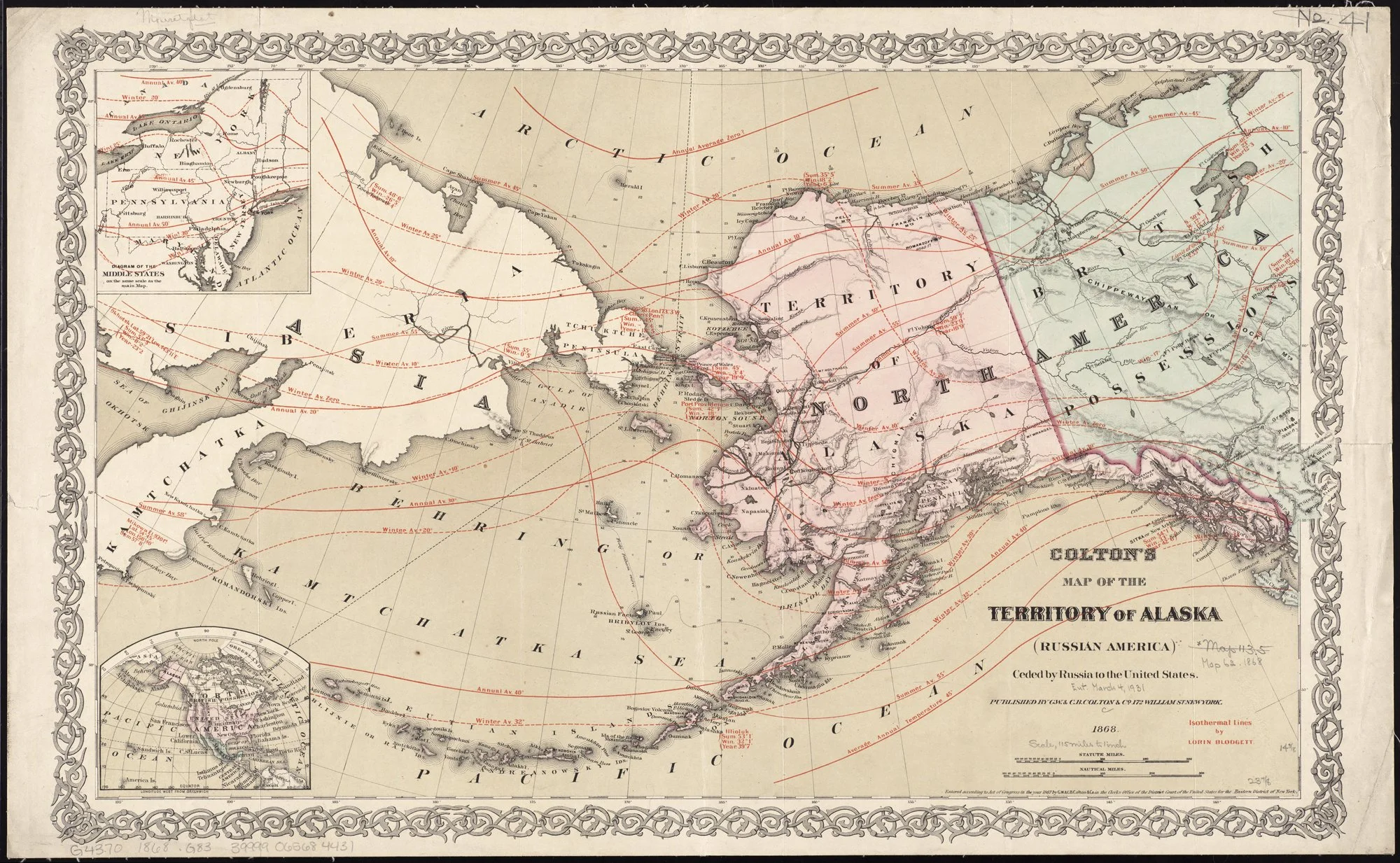
Colton's map of the territory of Alaska - (Russian America) ceded by Russia to the United States (G.W. & C.B. Colton & Co.).



_ceded_by_Russia_to_the_United_States_(13972186306).jpg)