Geopolitical Reconfiguration in the South Caucasus: Where Does Georgia Stand?
By Tamta Bezhanishvili
Recent political events taking place in the South Caucasus have significantly changed the region’s geopolitical order. The peace deal between Armenia and Azerbaijan ended the long-standing ethno-territorial dispute over the Nagorno-Karabakh region (known as Artsakh by the Armenian population) and resulted in the reduction of Russian influence. President Putin lost his monopoly over the negotiation process, ceding ground to the United States’ growing engagement in the region, which is emblematized by the deep American interest in playing a role in the peace process and contributing to the construction of the “Trump Route for International Peace and Prosperity” (TRIPP).
Armenia and Azerbaijan have both shifted their foreign policies out of alignment with Russia. Armenian Prime Minister Nikol Pashinyan has sought to escape from the Russian sphere of influence and find more reliable partners, such as the European Union (EU) and the United States, to provide peace and security and help the country grow economically. Meanwhile, Russo-Azerbaijani tensions have become more intense in recent months. Given Russia’s weakening position in the South Caucasus, in which it stands to lose influence over Armenia and cooperation with Azerbaijan, Georgia has turned out to be Russia’s most valuable asset in the region. Once perceived as a “beacon of liberty” in the South Caucasus surrounded by consolidated authoritarian regimes, Georgia has now chosen to distance itself from the West and pursue a foreign policy of multi-alignment—a pragmatism-based foreign policy strategy, which aims to establish relations with multiple, and at times even competing, international actors—which has been ineffective. By aligning itself with China, Russia, and Iran, while simultaneously consolidating authoritarianism domestically, Georgia has placed its strategic partnership with the United States and its multidimensional relations with Europe at risk. The suspension of the U.S.-Georgia Charter on Strategic Partnership exemplifies the deterioration of relations with Washington. Additionally, Georgia has withdrawn from the Parliamentary Assembly of the Council of Europe (PACE) and Georgian Dream (GD) officials have been sanctioned by the United States, Baltic states, Germany, Poland, and other European countries. Lastly, several cooperation frameworks such as Germany’s development cooperation with Georgia and the UK-Georgia Wardrop Strategic Dialogue, have also been suspended. However, instead of receiving any tangible benefits from this new emerging foreign policy strategy, GD was not even invited to China’s Victory Day parade on September 3, 2025 despite being a strategic partner, while Armenian and Azerbaijani officials attended the event. Moreover, in 2022, China and Russia both refused to support the resolution on the Status of Internally Displaced Persons (IDPs) and refugees from Abkhazia and the Tskhinvali region/South Ossetia in Georgia.
In spite of these failures, the question remains: how far might Georgia go in its pursuit of multi-alignment?
The New “Trump” Corridor Plan and Power Redistribution in the South Caucasus
The 2025 Peace Agreement between Armenia and Azerbaijan has geopolitical significance in the South Caucasus. TRIPP not only brings economic profit to regional powers but also presents an effective tool against Russian expansion. TRIPP, which is a modernized version of the Zangezur Corridor, connects Azerbaijan with its ethnic exclave, Nakhchivan, and contributes to the de-securitization and stabilization process between Armenia and Azerbaijan which has been an issue for the last forty years. However, the real winner out of this agreement appeared to be Turkey, which has consolidated its influence in the South Caucasus by securing two separate roads linking itself to the Caspian Sea and Central Asia through Georgia and Armenia, respectively.
Turkey’s gains mark a turning point in the game of leverage between President Erdoğan and President Putin, both of whom strive for geopolitical dominance in the South Caucasus and the Middle East. By backing TRIPP, the United States contributes to the relative decline of Russian influence in the region. Furthermore, TRIPP addresses the shared concern of both Azerbaijan and Armenia over Russia’s monopoly on regional conflict mediation.
The Peace Agreement affects Iran as well. Tehran considers TRIPP to be a threat to its geopolitical interests, since it enables Turkey to increase its influence in the South Caucasus by exclusively connecting itself with Central Asia through two separate roads. This will enable Turkey to establish the Trans-Caspian Pipeline (TCP), which aims to pump gas from Turkmenistan and deliver it to the European market through Azerbaijan and the Southern Gas Corridor (SGC), thereby strengthening Turkey's role as a regional energy hub. Alongside energy interests, Turkey has established economic ties with Kazakhstan, Uzbekistan, and Kyrgyzstan that counterbalance China's increasing influence in the region. Furthermore, the construction of the TRIPP inhibits Iran’s access to Georgia’s Black Sea ports in case a corridor under extraterritorial control passes through Armenia, which presents the only friendly route connecting Iran with the European market.
Georgia’s choices now hinge on how its multi-alignment operates under these conditions. After Armenia’s foreign policy shift toward the West and Azerbaijan’s tendency to distance itself from Russia (especially after the Azerbaijan Airlines crash in 2024), the Kremlin has suffered a loss of influence in the region. Against this backdrop, Georgia emerges as Russia’s mainstay, enabling President Putin to preserve influence in the South Caucasus.
Georgia’s Political Transformation and Emerging Foreign Policy of Multi-Alignment
Georgia turns out to be Russia’s sole and most valuable asset in the region. Once perceived as a country striving for Euro-Atlantic integration, it has ended up serving as Russia’s ‘trump card.’ Russia’s full-scale war in Ukraine has emerged as a turning point for Georgia’s foreign policy. The ruling Georgian Dream party began isolating itself from the West instead of continuing to pursue EU accession.
What factors drove GD to consolidate authoritarianism domestically and pivot its foreign policy toward illiberal powers? The answer lies in the oligarch Bidzina Ivanishvili’s power-seeking agenda. Russia’s full-scale war in Ukraine opened a ‘window of opportunity’ for EU membership for the Associated Trio-Georgia, Ukraine, and Moldova. However, given that Georgia’s pursuit of EU membership and its efforts to meet the Copenhagen Criteria—strengthening democracy, establishing a competitive market economy, and implementing common European policies—directly threaten the core pillars of GD’s governance, the ruling party saw its survival in distancing itself from the West and reinforcing a foreign policy of multi-alignment.
In spite of GD’s determination to deepen cooperation with China, Russia, and Iran, the consequences of multi-alignment have not been favorable for Georgia. These strategic moves will likely lead the country to increased political isolation, in which it will face aggressive Russia alone.
The Georgian case is a perfect example of why not all states are capable of pursuing a foreign policy of multi-alignment. Without a strategic value strong enough (e.g., substantial natural gas supplies) to overshadow a country’s shortcomings such as authoritarian tendencies and cooperation with illiberal states, multi-alignment is rarely an effective strategy. By contrast, multi-alignment is well-suited for Azerbaijan, which owns vast natural resources that make it difficult for great powers to ignore.
GD tends to explain its foreign policy shift from a neorealist perspective. According to the party’s narrative, the geopolitical system of the region forces Georgia to adopt pragmatic relations with Russia in order to prevent a potential war. This is a view that closely aligns with the neorealist perspective of John Mearsheimer. By spreading disinformation and anti-European propaganda, planting irrational fear of a future war with Russia, and emphasizing the alleged threat to Georgian traditions and moral values, GD aims to mobilize its electorate and ultimately to present Ivanishvili’s priorities as corresponding to national interests.
By upending Georgia’s value-based foreign policy, which implies striving for Euro-Atlantic integration as is written in the Constitution of Georgia, and instead adopting a foreign policy of multi-alignment, GD puts various benefits received from the EU (such as visa liberalization, the EU candidate status, and enormous amounts of financial aid) under threat. Furthermore, this approach undermines Georgia's relations with the United States as evidenced by the suspension of the Strategic Partnership in 2024, which aimed to develop Georgia’s military capabilities, prepare it for NATO candidacy, and invest in Georgia's economy in order to enable its economic security and independence.
Conclusion
Georgia’s emerging foreign policy of multi-alignment will likely lead the country into further political isolation from Western liberal powers until no states remain to reliably support the country against Russia. Under these circumstances, it will be easier for President Putin to draw Georgia further into Russia’s sphere of influence. Continuing to pursue a foreign policy of multi-alignment would undermine Georgia’s self-sufficiency and ultimately threaten its sovereignty.
To prevent Georgia from being pulled into Russia’s orbit to such a degree that no more positive changes could be made, far-sighted and rational decisions are essential. Instead of dissociating itself from the recent geopolitical developments in the South Caucasus, Georgia must do its utmost to seize the opportunity to restore its strategic significance in the region. More specifically, Georgia should create an attractive environment for foreign direct investments (FDI), improve its transportation system, actively engage in the recent geopolitical events taking place in the South Caucasus, participate in the negotiation process, and contribute to the TRIPP project. However, this cannot be managed in the context of a suspended strategic partnership with the United States and GD’s inefficient foreign policy of multi-alignment, which could result in the country becoming a proxy state instead of receiving tangible benefits from its currently deepening ties with multiple powers. Furthermore, Georgia should return to a value-based foreign policy and strive for Euro-Atlantic integration as a path capable of ensuring Georgia’s long-term security, stability, and economic prosperity.

Tamta Bezhanishvili is an undergraduate student in International Relations at Tbilisi State University and spent her fourth semester at Jagiellonian University, studying International Relations and Area Studies through the Erasmus+ Exchange Program. She is currently an Erasmus+ exchange student at the University of Limerick in Ireland, studying Politics and Public Administration. She is also a winner of the Chochua Fellowship, for which she wrote a report on global terrorism.
Tamta is one of the founders of the NGO “Young Diplomats' Club of Georgia,” which aims to raise students’ awareness of political events taking place not only in Georgia, but also in the international arena.
Her research interests focus on Russian politics, disinformation and propaganda mechanisms, the geopolitics of the South Caucasus, the resurgence of right-wing populism across Europe, and democratic backsliding.
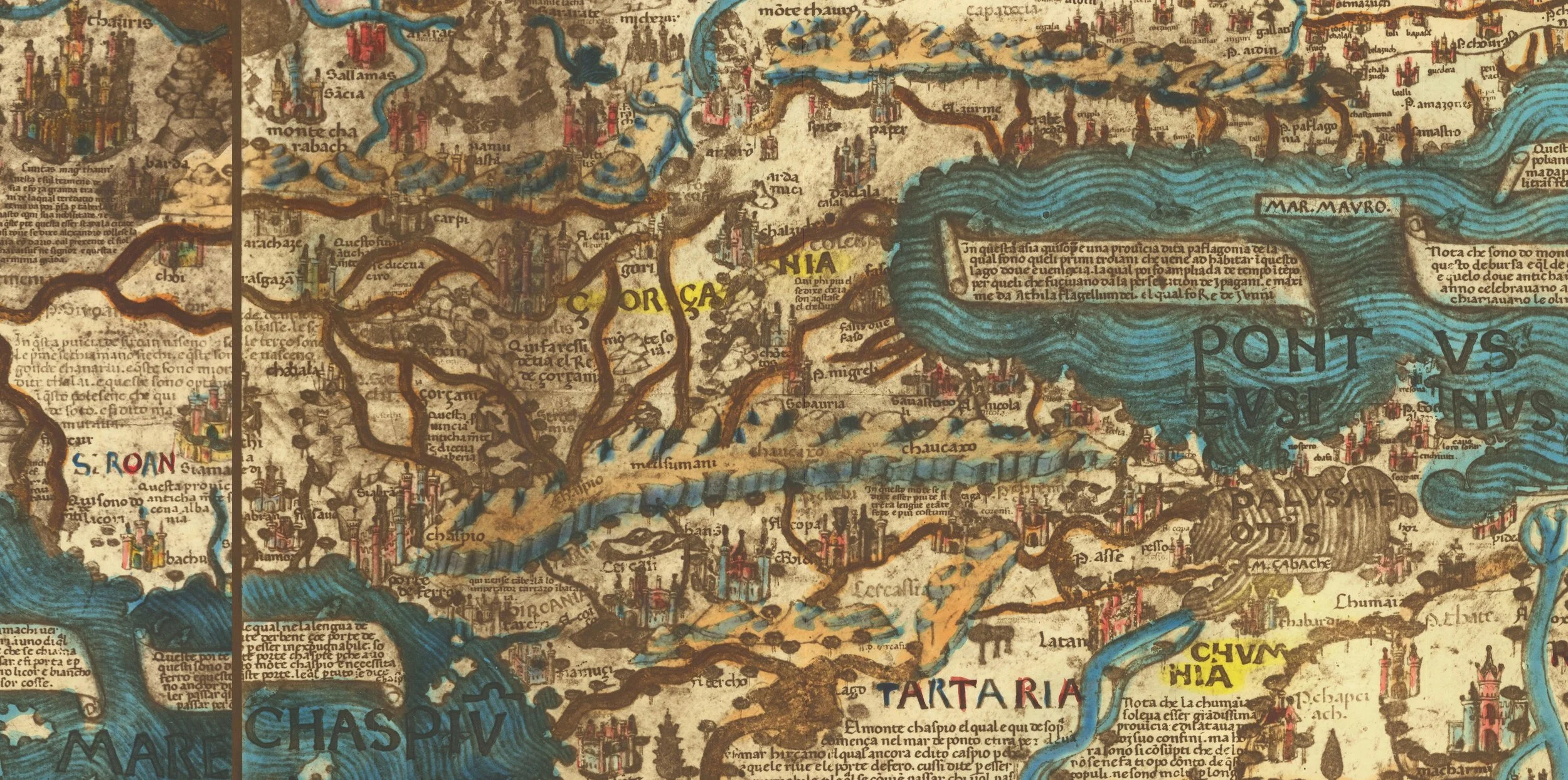
The Carlo Naya Facsimile of the Fra Mauro Mappa Mundi (Fra Mauro).
Licensed under CC0.